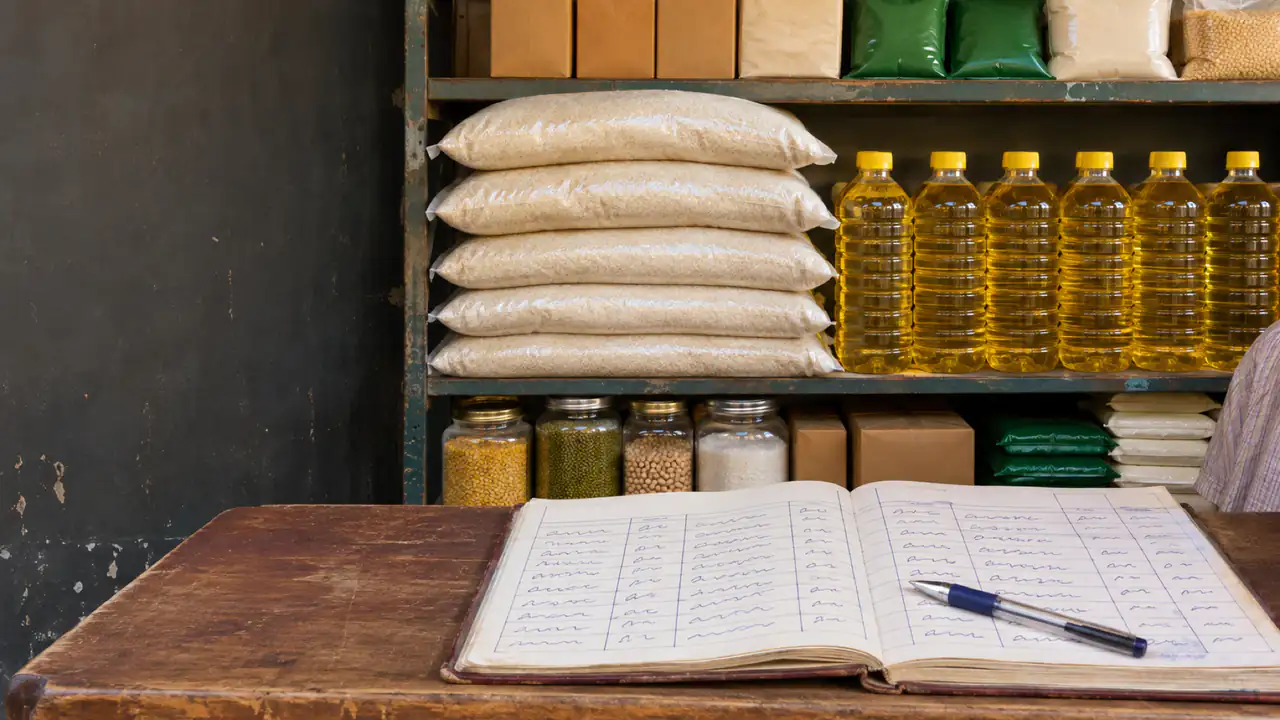
A stock register is a shop's record of every item: how much came in, how much went out, and how much should be on the shelf right now. Kept well, it tells you what to reorder, what sells slowly and whether anything has gone missing. Kept badly, it's a notebook nobody believes.
This guide covers the format most shops use, a filled-in example, the mistakes that make a register drift away from the shelf, and how to keep the same record on your phone without writing a line.
What a stock register is for
A good register answers three questions on any day:
- How much of each item do I have?
- What do I need to order, and how much?
- Does the shelf match the book, and if not, where did the difference go?
It can only answer them if every movement is written down: purchases, sales, returns, damaged goods, and anything taken out of the shop for home.
The stock register format
Give each item its own page, or its own block of rows. At the top, write the item's name, its unit (pack, bottle, kg, piece), the usual supplier, and the level at which you reorder. Then use these columns:
| Column | What goes in it |
|---|---|
| Date | The day the stock moved |
| Particulars | Who it came from or where it went: the supplier's name, "sales", "return", "damaged" |
| In | Quantity received |
| Out | Quantity sold or removed |
| Balance | Stock after this line: the last balance, plus In, minus Out |
| Rate | Cost price per unit, for purchases |
| Remarks | Bill number, expiry date, anything unusual |
That's the whole format. Shops that sell loose goods (sugar or rice by the kilo) add a column for the unit, so 250 g and 1 kg never get mixed up in the same total.
A filled-in example
Item: Basmati Rice 5 kg. Unit: pack. Reorder at: 10 packs.
| Date | Particulars | In | Out | Balance | Rate (Rs) | Remarks |
|---|---|---|---|---|---|---|
| 1 Nov | Opening stock | 18 | 1,020 | |||
| 2 Nov | Sales | 4 | 14 | |||
| 3 Nov | Sales | 5 | 9 | Below the reorder level | ||
| 4 Nov | Purchase, Ram Traders | 20 | 29 | 1,000 | Bill 2231 | |
| 5 Nov | Customer return | 1 | 30 | Torn bag | ||
| 5 Nov | Damaged | 1 | 29 | The same torn bag, thrown away |
Two things are worth noticing. On 3 Nov the balance fell to 9, under the reorder level of 10: that line is the signal to call the supplier, not the day the shelf is empty. And the torn bag appears twice, once coming back in and once going out as damaged. Skip either line and the book stops matching the shelf.
A blank stock register format to copy
Copy this into a notebook or a spreadsheet, one block per item. The last column turns the balance into money, which is what your stock is worth.
Item: ________ Unit: ________ Supplier: ________ Reorder at: ________
| Date | Particulars | In | Out | Balance | Rate | Value (Balance × Rate) | Remarks |
|---|---|---|---|---|---|---|---|
| Opening stock | |||||||
How often to update it
- Every day for fast movers: rice, oil, sugar, tea, noodles, biscuits, soft drinks.
- Count the shelf once a week for your ten or fifteen fastest items, and compare with the balance.
- Count everything at least once a year, when you work out the year's profit: a full stock take. How to do a stock take covers counting step by step.
The weekly count is the easiest one to skip, and it's the one that catches problems while they are still small.
Why paper registers drift from the shelf
When the balance and the shelf disagree, it's almost always one of these:
- Sales aren't written item by item. At a busy counter nobody writes "1 packet of noodles" three hundred times a day, so the Out column gets filled from memory at night, or not at all.
- Loose sales. Sugar bought in 50 kg sacks and sold in 1 kg bags needs a conversion every time, and every rounding adds up.
- Returns and damage aren't recorded. A swapped bottle or a burst packet leaves the shop without a line in the book.
- Things taken for home. Normal in a family shop, and invisible unless someone writes them down.
- Two people, one book. Each assumes the other wrote it.
None of these is theft, and it's worth knowing that before you start suspecting anyone. Count a few items weekly, and when the numbers disagree, check this list first.
Keeping a stock register in Excel
A spreadsheet is a step up from paper: one sheet per item, or one long sheet with a row per movement, and a formula that adds In, takes away Out and carries the balance down. It can't lose a page, and it can add up a whole month in a second.
It still needs every sale typed in by hand, though, and that is exactly the step that fails at a busy counter. A spreadsheet fixes the arithmetic, not the habit. That's the gap a billing app closes: in a free app such as BSMM, the bill itself is the register entry, whether one person runs the counter or several staff do.
A stock register app that keeps itself
In a billing app the register is a side effect of selling. In BSMM, a free billing, stock and khata app for shops:
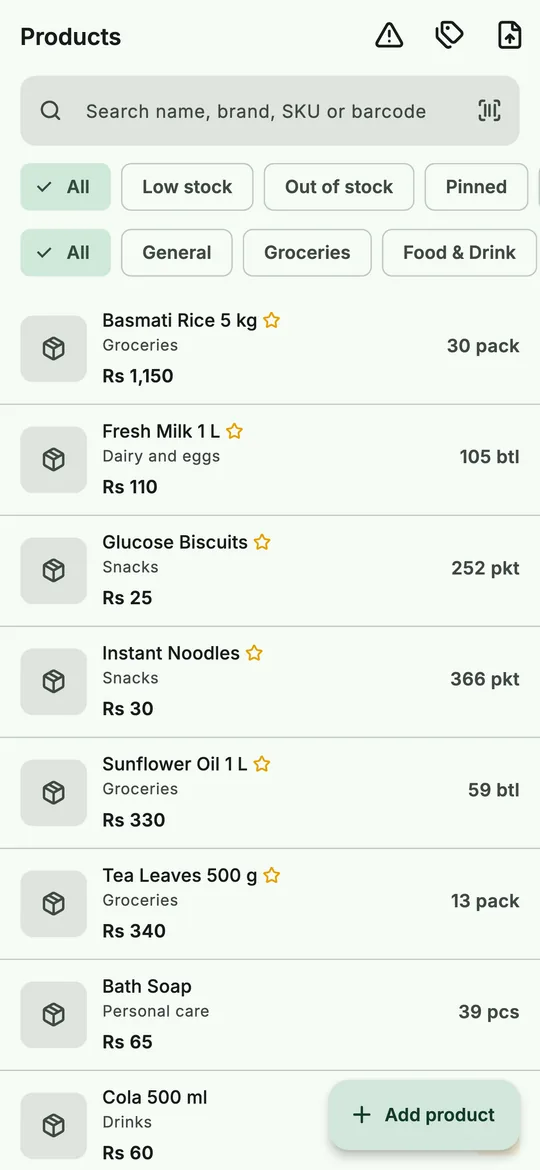 Stock on hand for every product, kept up to date by every bill and delivery.
- Every bill takes the items out, every purchase you enter with Stock in puts them back in, and returns put them back where they came from. Nobody writes the Out column.
- Each product has its stock history: every sale, purchase and adjustment, with the date. It's the same register, already filled in.
- Damage and the weekly count have their own place. Adjust stock lets you take items off as damaged, expired, lost, used in the shop or given away, or enter what you counted on the shelf, so the difference is recorded with a reason instead of disappearing.
- The reorder level is built in. Set "Warn when stock is at or below" on any product, and it shows on the low-stock list and a ready-made reorder list when it gets there.
- Purchases are kept at average cost, so the value of your stock is right even when the price changes from one delivery to the next.
- You don't start from zero. Products can be imported from a spreadsheet, opening stock and all.
It works without the internet, and staff on their own phones all add to the same stock. If you already keep a paper register, the easiest way to switch is to start with your twenty fastest items and let the app run beside the book for a week.
Questions shopkeepers ask
Is a stock register required by law? Rules depend on your country, your turnover and whether you're registered for VAT or GST. In India, GST-registered businesses must keep an account of the goods they receive and supply, including goods lost, destroyed or written off (Rule 56 of the CGST Rules). Elsewhere, ask your accountant what they need to see. A register is good practice for any shop either way.
What's the difference between a stock register and a stock book? Nothing: stock register, stock book, stock maintenance book and stock ledger are names for the same record. A bin card is a smaller cousin, kept with the item itself, that records quantities only.
Should the Rate column use the cost price or the selling price? The cost price. Your stock is worth what you paid for it, and that's the number your profit is worked out from.
Next: how to set the level at which each item should be reordered, in Reorder level and reorder point, with a shop example.