Every shop has run out of something it sells every day: the cooking oil on a Saturday morning, the soft drinks on the hottest afternoon of the year. The fix is a number for each item, the reorder level (also called the reorder point): the amount of stock at which you place the next order, so the new delivery arrives before the shelf is empty. A little safety stock on top covers the busy days and the late deliveries.
This post explains the formula (including the textbook version used in cost accounting exams), works it through with a real shop item, and gives a simpler rule of thumb for a busy counter.
Reorder level and reorder point: the same thing
Both names mean the stock level that triggers a new order. "Reorder point" is more common in business books and software; "reorder level" is the term in Indian and Nepali commerce textbooks. This post uses reorder level.
Reorder point formula
Reorder level = average daily sales × lead time + safety stock
- Average daily sales: how many units you sell on a normal day.
- Lead time: how many days pass between placing an order and having the goods on your shelf.
- Safety stock: a cushion for the busy day or the late delivery.
The first part, daily sales × lead time, is what you'll sell while you wait for the delivery. The safety stock is what stops a surprise from emptying the shelf.
A worked example
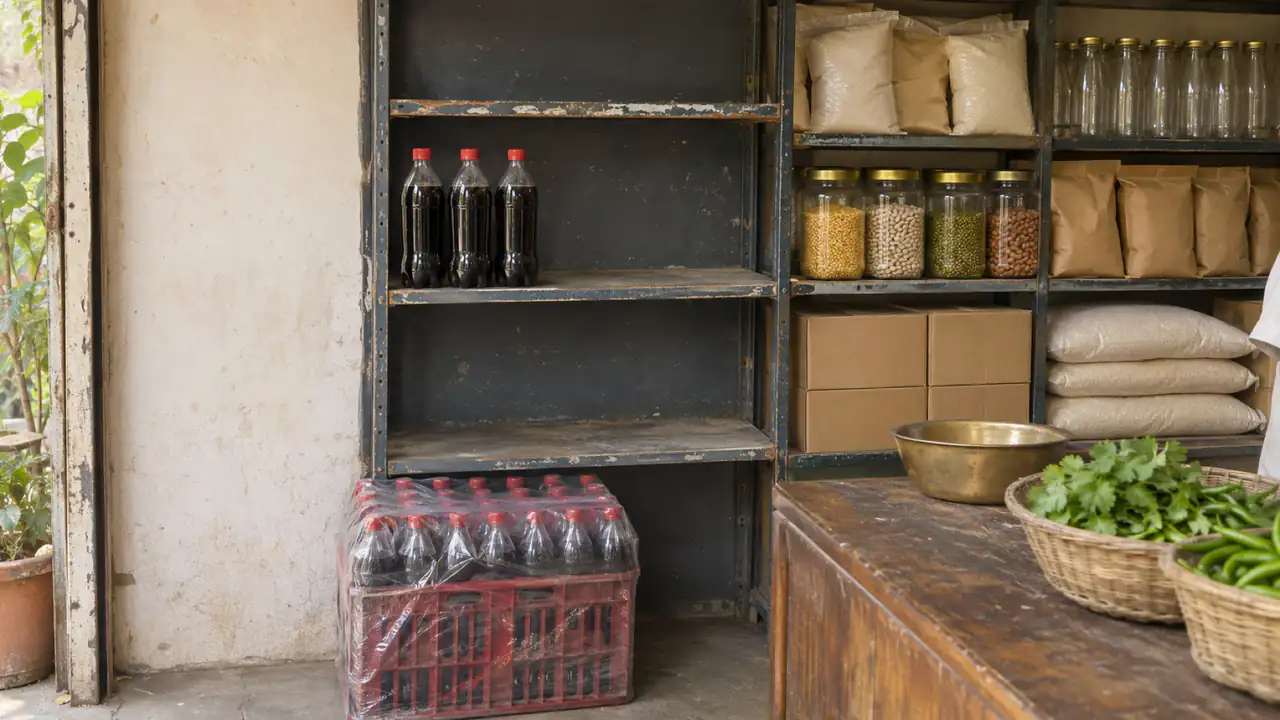
Take Cola 500 ml in a small grocery:
- On a normal day it sells 4 bottles. On the busiest days, 6.
- The distributor usually delivers 2 days after you call. When they're late, 3 days.
Safety stock covers the worst case: the busiest days during the slowest delivery, minus what you'd normally sell.
Safety stock = (6 × 3) − (4 × 2) = 18 − 8 = 10 bottles
Reorder level = (4 × 2) + 10 = 18 bottles
So when the cola gets down to 18 bottles, you order. On a normal week you'll still have about 10 left when the crate arrives; on a bad week you'll just make it.
How to calculate safety stock
The example uses the simplest safety stock formula, the one most shops and commerce courses use:
Safety stock = (maximum daily sales × maximum lead time) − (average daily sales × average lead time)
Inventory software for large businesses often uses a statistical version instead: a service factor (how often you're willing to run out) × how much daily sales vary × the square root of the lead time. It needs months of daily sales data; for a small shop the simple formula, checked against what really happens, works well.
The textbook formulas (cost accounting)
Commerce and cost accounting courses use a set of stock levels with fixed formulas. They give the same answer as above, in fewer steps:
| Level | Formula | Cola example |
|---|---|---|
| Reorder level | Maximum usage × maximum lead time | 6 × 3 = 18 |
| Minimum level | Reorder level − (average usage × average lead time) | 18 − (4 × 2) = 10 |
| Maximum level | Reorder level + reorder quantity − (minimum usage × minimum lead time) | 18 + 24 − (2 × 1) = 40 |
| Average stock | Minimum level + half the reorder quantity | 10 + 12 = 22 |
| Danger level | Average usage × lead time in an emergency | 4 × 1 = 4 |
The example assumes you order one crate of 24 bottles each time, that the slowest days sell 2 bottles, and that the fastest delivery takes 1 day. Notice that the minimum level is the same as the safety stock: it's the stock you should never go below. Some textbooks work out average stock as (maximum level + minimum level) ÷ 2 instead, which here gives (40 + 10) ÷ 2 = 25; use whichever your course uses. The danger level assumes an emergency order can arrive in 1 day.
A simpler rule for a busy shop
Nobody at a kirana counter works out maximum usage for 400 items. This rule gets close enough:
- Count a week's sales of the item and divide by 7. That's your daily sales.
- Ask the supplier how many days a delivery takes, and add 2 days for the times they're late.
- Multiply the two. That's your reorder level.
For the cola: 28 bottles a week is 4 a day; a 2-day delivery plus 2 spare days is 4 days; 4 × 4 = 16 bottles. Close to the textbook's 18, and easy to redo whenever things change. Once the levels are set, a stock app can do the watching: BSMM flags each item as it reaches its level, whether you stock fifty products or several thousand.
How much to order
The reorder level tells you when to order. The reorder quantity tells you how much. For a small shop, three things decide it:
- Pack sizes. Suppliers sell in crates, cartons and sacks, so round up to the next whole one.
- Shelf life. Order no more than you'll sell well before the expiry date. Milk, bread and eggs get small, frequent orders; rice and salt can come in bulk.
- Cash. Money on the shelf isn't in the drawer. Ordering a month of everything at once can leave you short for the things that sell fastest.
Big businesses use a formula called the economic order quantity for this. For a shop, pack sizes and expiry dates matter more than the formula.
Set higher levels before the festival season
Sales aren't steady all year. Before Dashain and Tihar, ghee, sugar, oil, rice and soft drinks can sell much faster, and suppliers get slower at exactly the same time, because every shop is ordering. Raise the reorder level for those items a few weeks ahead, and bring it back down afterwards.
Keeping reorder levels in an app
Working this out is half the job. The other half is noticing when an item crosses the line, which is hard when you sell hundreds of products.
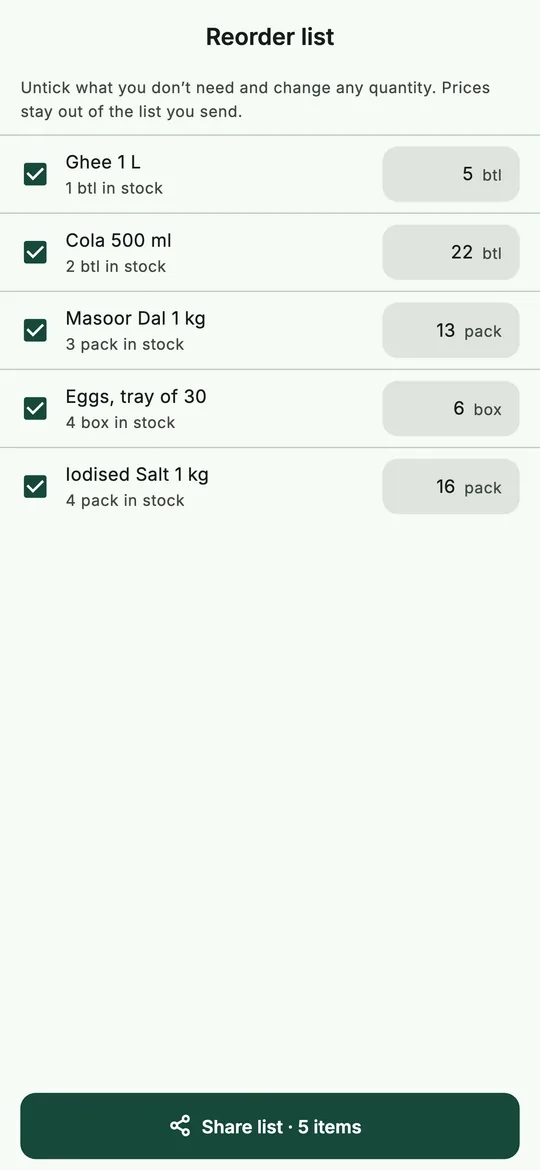 The reorder list: what's at or below its warning level, with a quantity to order.
In BSMM, the free stock and billing app, each product has a setting called "Warn when stock is at or below". Put your reorder level there (or leave it empty to use one level for the whole shop). Stock goes down by itself with every bill, so:
- Items at or below their level show on the low-stock list.
- The reorder list gathers them in one place and suggests a quantity, enough to get back to twice the warning level, which you can change.
- You can share the list with your supplier on WhatsApp. It holds the items and quantities only, never your prices or stock.
The weekly count still matters, because the warning is only as good as the stock number behind it. How to keep a stock register covers that.
Questions shopkeepers ask
What's a good safety stock for a small shop? Two or three days of normal sales is a sensible start for most items. Give more to items customers will walk out over (milk, cooking oil, rice) and less to items that expire quickly.
Should every item have a reorder level? Start with the fast movers: the 20 or 30 items that make up most of your sales. Slow sellers can be checked once a week by eye.
What if an item never runs out but sits for months? Then the problem isn't the reorder level: it's dead stock. Read how to spot and clear dead stock.