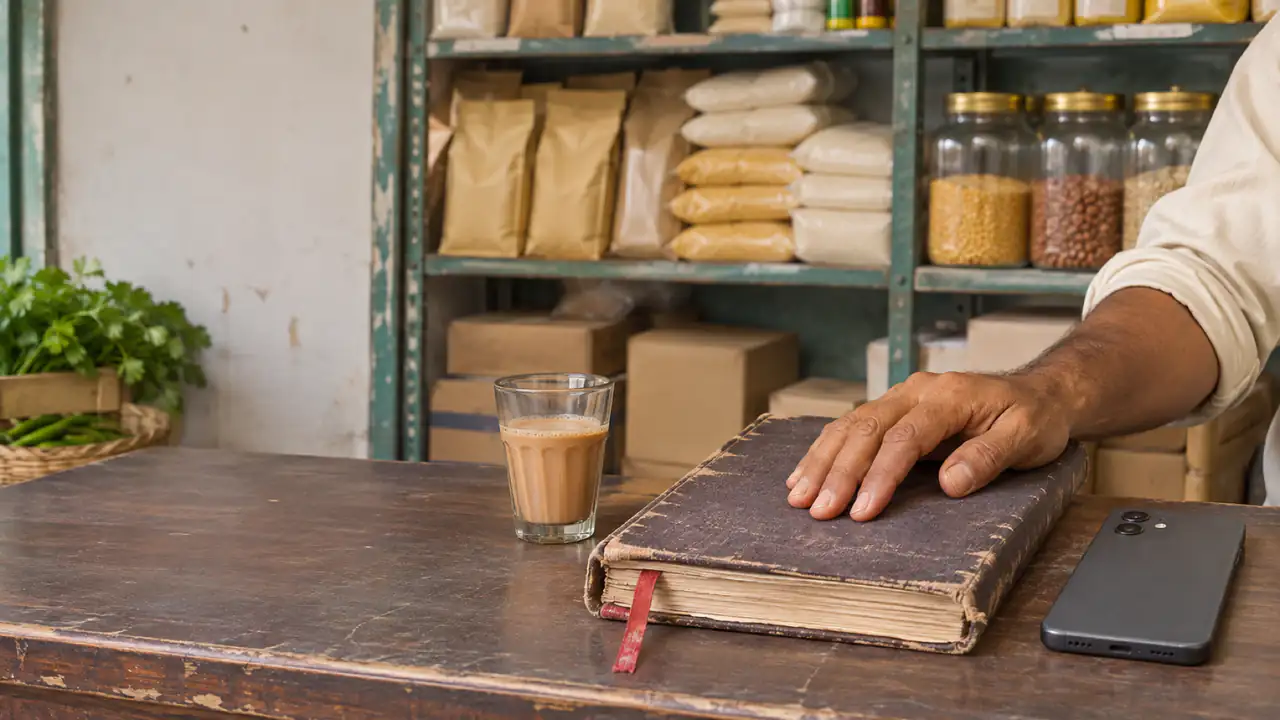
Udharo (udhaar, or udhar khata in India) keeps a neighbourhood shop going. Regular customers buy on credit through the month and settle up when the salary comes in, and the shop that offers it keeps its customers. The trouble is the book. A paper khata gets smudged, lost, argued over and forgotten, and the money in it is often the biggest sum the shop is owed.
This guide covers how to give credit without losing money or customers, what a digital khata changes, and what to look for in a khata app.
Why the paper bahi khata fails
The traditional bahi khata works when one person writes every entry, the book never leaves the counter, and nobody disputes anything. In practice:
- Entries get missed. A busy evening, a family member at the counter, "I'll write it later".
- There's no running total. Working out what a customer owes means adding up pages, and every addition is a chance for a mistake.
- Disputes have no detail. "I paid you Rs 500 last week" is hard to answer when the page only says "500".
- Reminding people is awkward. Asking a regular for money face to face is the part most shopkeepers put off, so balances grow.
- One book, one place. It can be lost, damaged by water, or simply be at home when the customer is at the shop.
Rules for giving udharo
Whatever you write it in, these keep credit under control:
- Write it at the counter, every time. The date, the items or the bill, and the amount. Not at the end of the day.
- Set a limit for each customer. A comfortable amount for a family that pays every month; a smaller one for someone new.
- Agree on when it's settled. Month end, salary day, or every fortnight. A date makes the reminder normal instead of personal.
- Record part payments as they happen. Rs 1,500 off a Rs 7,000 balance is worth writing down the same minute.
- Keep supplier credit separate. What you owe your suppliers is a different book from what customers owe you.
- Look at the total every week. The sum of all udharo is money the shop has earned but can't spend yet.
Asking for the money, politely
Most balances go bad not because people won't pay, but because nobody asked. A few things make it easier:
- Time it well. A few days after salary day, and before Dashain, when many people receive their festival allowance.
- Send the exact figure. "Your balance at the shop is Rs 7,615" is easier to act on than "please clear your dues".
- Keep it friendly and short. A message on WhatsApp is less awkward for both of you than asking in front of other customers.
- Show the detail if asked. A list of bills and payments with dates settles most disputes in a minute.
What a digital khata changes
A khata on your phone does what the paper book can't:
- The balance is always worked out. Every credit sale adds to it, every payment takes from it.
- Every entry carries its detail: the date, the bill and the items on it.
- Reminders are one tap, with the exact amount filled in.
- It can be backed up, so losing the phone needn't mean losing the book.
- Everyone at the counter uses the same khata, on their own phones.
In an app that also makes the bills, such as BSMM, there's nothing extra to write: a credit sale lands on the customer's page as it's charged, at a single counter or across several staff phones.
What to look for in a khata app
Many khata apps are ledgers only: you type in an amount, and the app keeps a balance. That's better than paper, but it doesn't know what was sold. Things to check:
- Is it linked to your bills? If credit sales are made at the counter, the khata should fill itself in from the bill, items and all.
- Does it work offline? The counter can't stop when the internet does.
- Is it free, and does it stay free? Check for paid plans, limits and ads before your customers' records are inside it.
- Can you get your data out? A backup you control matters for something this important.
- Can staff use it on their own phones without sharing one login?
A free khata app linked to your bills
BSMM is a free billing, stock and khata app made at a family shop in Pokhara. Its khata is part of the counter:
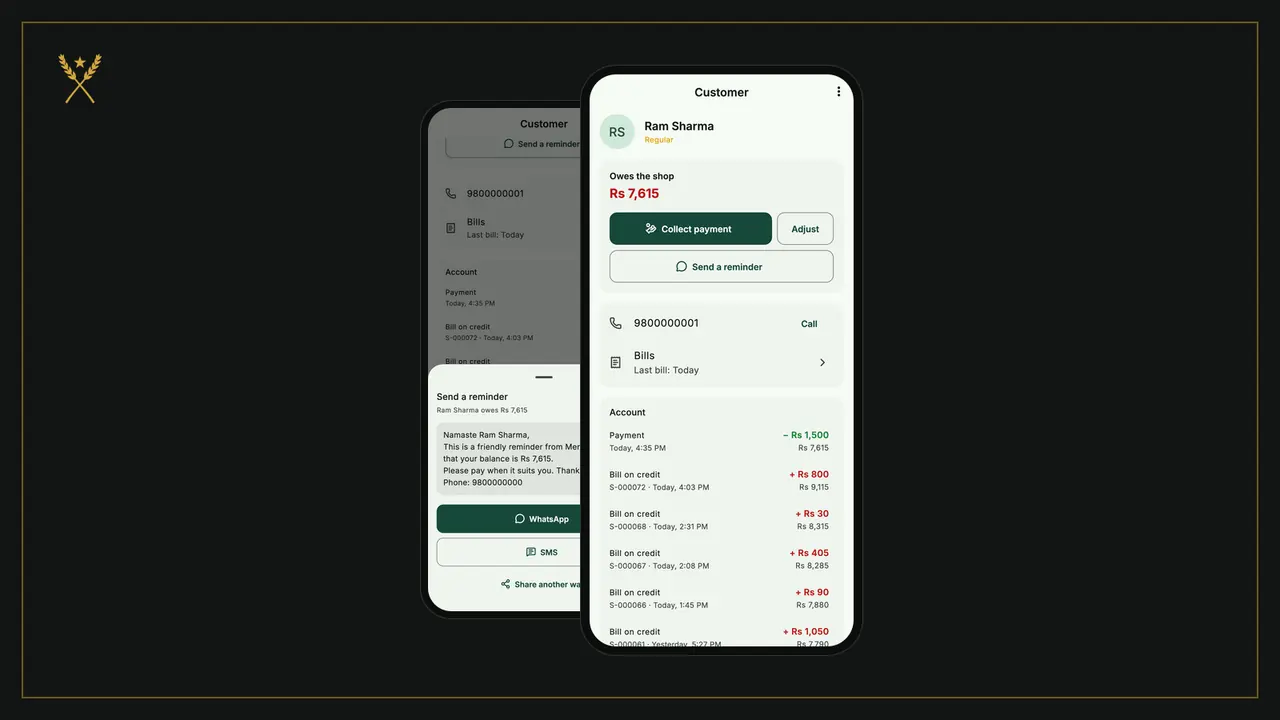
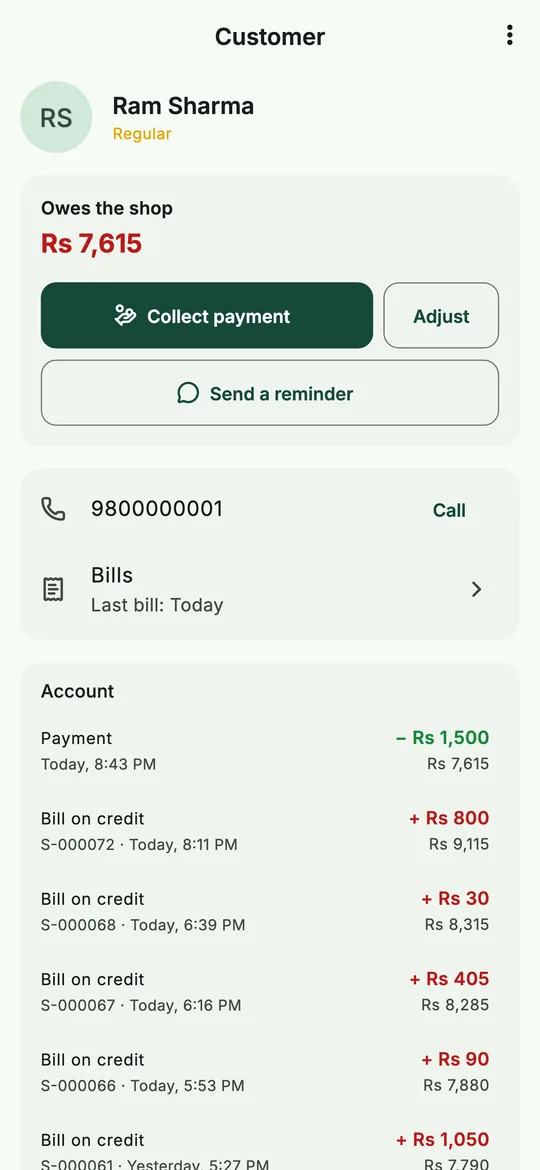 One regular's khata page: the balance, every credit bill and every payment.
- Put a bill on credit when you charge it, and it goes on that customer's account with its items.
- Each regular has one page: their balance, their bills and their payments, in order.
- Collect in parts, and every payment is recorded with its date.
- Send a polite reminder by WhatsApp or SMS, with the amount filled in.
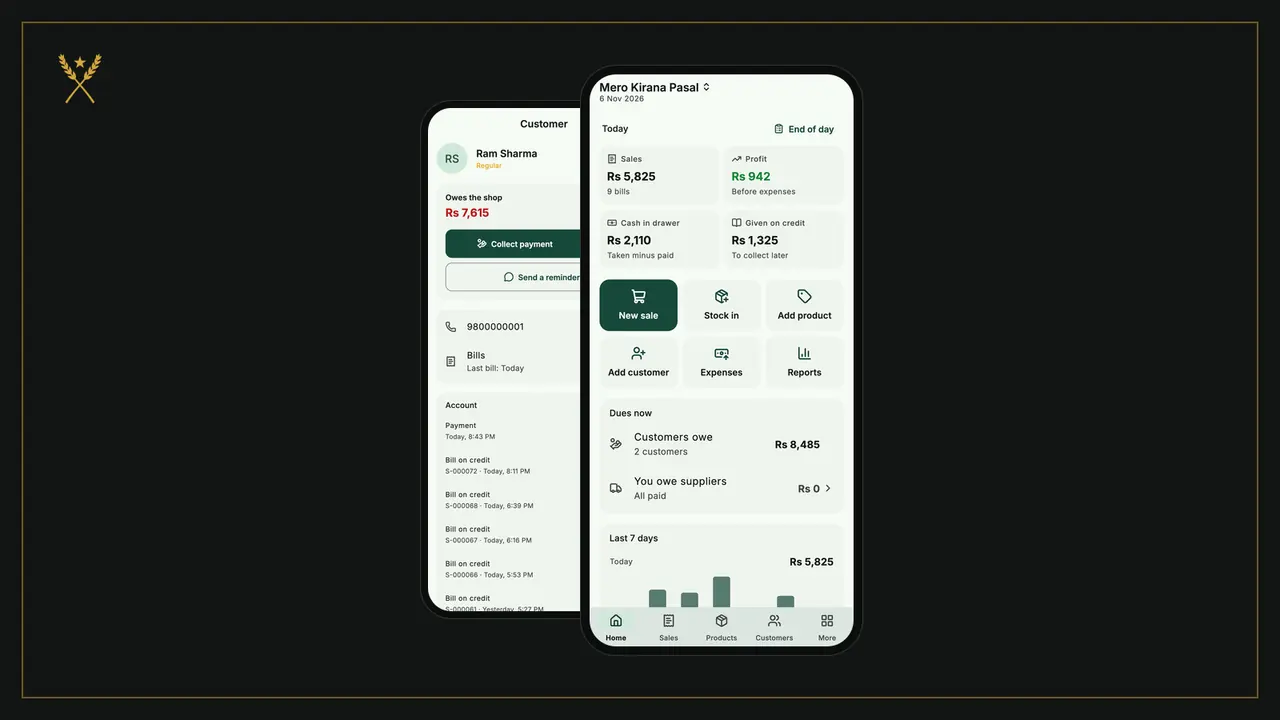
- See the total customers owe on the home screen, next to what you owe your suppliers.
- Customer orders with an advance, for the regular who wants something kept aside.
It works without the internet, every staff member's phone shows the same khata, and everything can be backed up to one file. The app is in English. For other apps side by side, see inventory and billing apps compared.
Questions shopkeepers ask
Should I charge interest on udharo? Many neighbourhood shops don't, and customers don't expect it. A clear limit and a settle-up date work better than interest for keeping balances small.
Is a digital khata proof in a dispute? It's a dated record of every bill and payment, which settles almost every disagreement at the counter. It isn't a signed agreement, though, so for large or business credit, keep whatever paperwork your accountant advises.
Which khata app is free with no ads? Many khata apps are free to start, with ads or paid plans for more features. BSMM is free with no ads and no paid plan, and its khata is linked to your bills and stock.
Is my customers' data safe in a khata app? Check who can see it, whether you can lock the app and whether you can back it up. In BSMM, the app can be locked with a PIN or fingerprint, only your shop's members see its records, and everything can be backed up to one file.
What if a customer never pays? Stop new credit first, then ask clearly with the exact amount. If the balance is small and the customer was good for years, some shops quietly write it off rather than lose the relationship. Either way, record what you decide, so your books show it.
Next: how to calculate your shop's real profit, where udharo makes the difference between profit and cash.