"The drawer was full today" and "the shop made money today" are not the same sentence. Sales include the cost of the goods you sold; the drawer includes old udharo someone paid back; and neither shows the rent, the electricity or the packet of biscuits that went home.
This guide shows how to work out a shop's real profit, step by step, with the numbers from one ordinary day.
Sales, profit and cash are three different numbers
- Sales: the total of the day's bills.
- Profit: what's left of those sales after the cost of the goods and the shop's expenses.
- Cash: the money that actually came in, in the drawer and in your wallets.
A shop can have high sales and little profit (thin margins), or good profit and little cash (lots of udharo). You need all three to know how the shop is doing.
Step 1: gross profit
Gross profit = sales − cost of the goods sold
The cost of goods is what you paid for the items that went out on the bills, not for everything you bought that day. Working that out bill by bill is the hard part by hand; billing apps that keep cost prices, such as BSMM, do it as each bill is made.
Here's one day in the BSMM app's demo shop (sample figures):
| Amount | |
|---|---|
| Sales (9 bills) | Rs 5,825 |
| Cost of the goods on those bills | Rs 4,883 |
| Gross profit | Rs 942 |
Step 2: net profit
Net profit = gross profit − expenses
Expenses are what it costs to keep the shop open: rent, electricity, staff wages, transport, phone and internet, plastic bags, repairs. They're usually paid monthly, so work net profit out monthly too.
| A month | Amount |
|---|---|
| Gross profit (about Rs 942 a day, 30 days) | Rs 28,260 |
| Rent | Rs 8,000 |
| Electricity and water | Rs 1,800 |
| Transport and phone | Rs 2,200 |
| Bags and small supplies | Rs 900 |
| Net profit | Rs 15,360 |
The rent and the bills in this example are made up, but the lesson isn't: almost half the gross profit went on keeping the doors open. Expenses you don't write down are profit you think you made.
Profit margin formula, markup and profit percentage
Two ways to describe the same profit, and mixing them up is one of the most common pricing mistakes:
- Margin = profit ÷ selling price × 100
- Markup = profit ÷ cost price × 100
Take Basmati Rice 5 kg, bought at Rs 1,000 and sold at Rs 1,150. The profit is Rs 150.
- Margin: 150 ÷ 1,150 × 100 = 13.0%
- Markup: 150 ÷ 1,000 × 100 = 15.0%
Markup is what school maths calls profit percentage: (selling price − cost price) ÷ cost price × 100. If the selling price is below the cost, it's a loss: loss % = (cost price − selling price) ÷ cost price × 100.
If you want a 15% margin, a 15% markup isn't enough. The selling price for a 15% margin is cost ÷ 0.85, which for the rice is about Rs 1,176.
For the whole day above, the gross margin is 942 ÷ 5,825 × 100 = 16.2%. Groceries often run on thin margins, so a few percent either way matters a lot. The net margin for the month above is 15,360 ÷ 1,74,750 (that's 5,825 × 30 days of sales) × 100 = 8.8%.
When the cost price keeps changing
Prices change from one delivery to the next. If you bought 10 packs of rice at Rs 1,020 and then 20 more at Rs 1,000, which cost do you use?
The usual answer is the average cost:
(10 × 1,020 + 20 × 1,000) ÷ 30 = 30,200 ÷ 30 = Rs 1,006.67 a pack
Using the newest price makes profit look better or worse than it was; the average keeps it honest.
Why profit and cash don't match
Here's how the same day's money actually came in:
| Amount | |
|---|---|
| Sales | Rs 5,825 |
| Given on credit (udharo) today | − Rs 1,325 |
| Old udharo collected today | + Rs 1,500 |
| Money received | Rs 6,000 |
| Of which: cash in the drawer | Rs 2,110 |
| Fonepay | Rs 2,390 |
| eSewa | Rs 1,500 |
The drawer looks better than the day was, because a customer paid off old credit. On another day, with lots of new udharo and nothing collected, the drawer would look worse than the day was. Neither tells you the profit.
What quietly eats profit
- Udharo that's never paid. It was counted as a sale and as profit; if it never comes in, it becomes a loss (a bad debt). See how to manage udharo.
- Damaged, expired and dead stock. Anything thrown away or sold below cost is a loss, whether or not you write it down. See how to spot dead stock.
- Things taken for home. Fair in a family shop, but they're goods that left without a sale.
- Discounts and free items. Rounding down a bill or adding a free sweet is a small cost, every time.
- Supplier prices you didn't notice. If the cost went up and your selling price didn't, the margin shrank.
A simple routine
- Every day: look at the day's sales, gross profit and what came in.
- Every week: check your fastest items' margins against the latest supplier prices.
- Every month: add up the expenses and work out net profit. Compare it with last month, not just with the sales.
Profit worked out for you
Doing this by hand means knowing the cost of every item on every bill, which is the hard part. In BSMM, the free billing and stock app for shops:
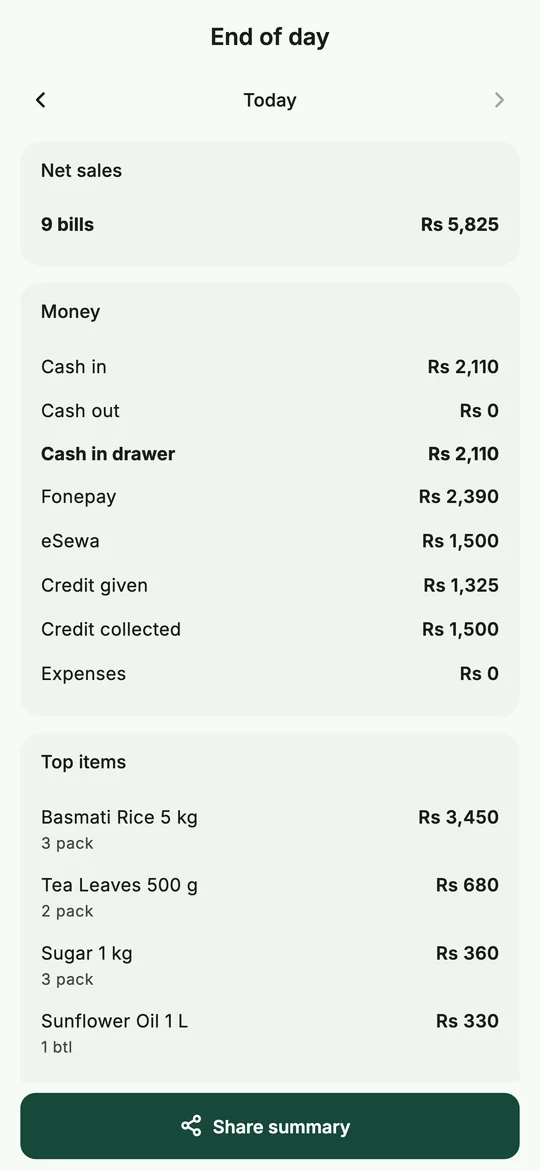 The day-end summary: the day's money, by cash, wallets and credit.
- Today's sales and profit are on the home screen the moment you open the app.
- Purchases are kept at average cost, so the cost of every item sold is already known.
- Reports for any day, week or month show gross profit, net profit, best sellers and stock value.
- Expenses go in as they're paid, so net profit is real.
- The day-end summary adds up cash, Fonepay, eSewa, credit given and credit collected, ready to share.
Questions shopkeepers ask
What's a good profit margin for a grocery or kirana shop? It varies a lot by item: staples like rice, sugar and oil often carry thin margins, while snacks, cosmetics and household goods usually carry more. Your own reports are the best guide: compare your margin by item and by month. How to run a kirana store works through margins by kind of goods.
Should I count udharo as profit? Count it as a sale when the bill is made, and keep an eye on how much of it comes in: credit that's never paid turns that profit into a loss.
Is profit before or after my own salary? If you pay yourself a fixed amount, treat it as an expense. If you just take what's left, net profit is what you earned for your work.