Price is the one thing in a shop you can change in a minute, and it changes everything: how fast items sell, how much each sale earns, and what customers think of the shop. Yet most small shops price the same way every time: cost plus a round number, or the printed MRP.
This guide covers the pricing strategies that work for a small shop, from simple cost-plus to charm pricing and bundles, with the arithmetic for each.
Start from cost, not from the competitor
Before any strategy, know your real cost for each item: what you paid, including transport, divided by what you can actually sell (minus breakage and expiry). If you bought 24 bottles for Rs 2,160 and 1 usually breaks, your real cost is 2,160 ÷ 23 = Rs 93.91 a bottle, not Rs 90.
Prices set without the real cost are guesses.
Strategy 1: cost-plus (markup) pricing
Selling price = cost × (1 + markup %)
A 15% markup on a Rs 100 item gives Rs 115. It's simple and works for most goods, but remember that a 15% markup is only a 13% margin (15 ÷ 115). If you need a margin, work backwards:
Selling price = cost ÷ (1 − margin %)
For a 15% margin on Rs 100: 100 ÷ 0.85 = Rs 117.65. How to calculate your shop's real profit explains margin and markup.
Strategy 2: printed price (MRP) items
For goods with a printed maximum retail price, your room to move is below it: the supplier's price decides your margin. The strategy here is buying: compare distributors, buy in the quantities that earn a better rate, and ask about schemes. Selling below MRP can win customers on items people compare (oil, rice, milk powder), but only where the margin allows.
Strategy 3: what is charm pricing?
Charm pricing means ending prices just below a round number: Rs 99 instead of Rs 100, Rs 495 instead of Rs 500. Shoppers tend to read the left-most digit first, so Rs 99 feels closer to 90 than to 100.
It isn't only folklore. In field experiments with a clothing catalogue, the researchers Eric Anderson and Duncan Simester found that prices ending in 9 sold more than nearby prices, sometimes more than a slightly lower price (Anderson and Simester, 2003). The effect was strongest on items whose price customers didn't already know.
When to end a price in 9: on goods you price yourself and customers can't easily compare: loose items, home-made products, your own bundles, and bigger tickets (Rs 199, Rs 499, Rs 999). That is where a price ending carries the most weight.
When to end in 5 or 0: on small, frequent purchases, where Rs 99 or Rs 49 means hunting for coins at a busy counter. Rs 45 or Rs 95 keeps change simple and still sits below the round number. Many shops use charm prices on bigger items and round prices on small ones.
Try it on a few items for two weeks and compare how many sold before and after.
Strategy 4: value pricing for "known value items"
Customers remember the prices of a few items (rice, sugar, oil, milk, eggs) and judge the whole shop by them. Keep those known value items keenly priced, even on thin margins, and earn more on items people don't compare as closely: snacks, household goods, personal care.
Strategy 5: bundles
A bundle is two or more items sold together at a small discount: tea and biscuits, a pack of noodles with eggs, a festival pack. Bundles raise the average bill and move slow items alongside fast ones.
Price a bundle so the discount comes out of the slower item's margin, not the faster one's. If tea, a fast seller, earns Rs 25 and a slow biscuit pack Rs 8, a Rs 5 discount still leaves Rs 28 on the pair; a Rs 20 discount leaves Rs 13, less than the tea earns on its own.
Strategy 6: quantity pricing
"1 for Rs 30, 4 for Rs 110." Quantity pricing moves more units at a slightly lower margin each, which suits fast items with long shelf lives. Avoid it for anything that expires soon: four packets that go stale at home are a customer's bad memory of your shop.
Strategy 7: clearance pricing
Near-expiry and slow stock should be priced to go before it becomes a total loss. A clear "Rs 20 off" label sells more than a quiet price cut. See dead stock and FIFO vs FEFO.
Which strategy for which item
| Kind of item | Strategy |
|---|---|
| Rice, oil, sugar, milk (people compare) | Value pricing, keen prices |
| Snacks, household, personal care | Cost-plus with a healthy margin |
| Your own loose or home-made goods | Charm pricing |
| Slow movers | Bundles, then clearance |
| Long-life fast movers | Quantity pricing |
Check that your prices earn money
A price is only right if the item actually makes money after its real cost. Look at each item's margin every month, especially after a supplier raises prices; a margin that was 15% can be 9% after two price rises you didn't pass on.
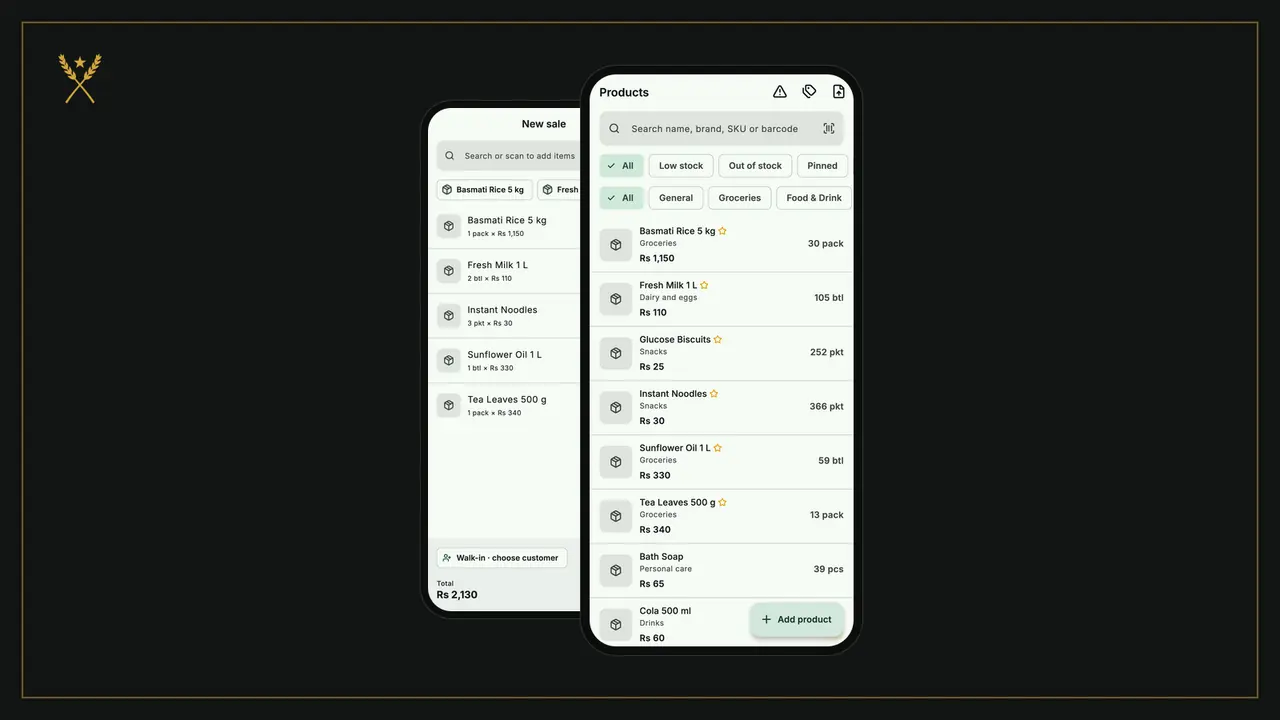
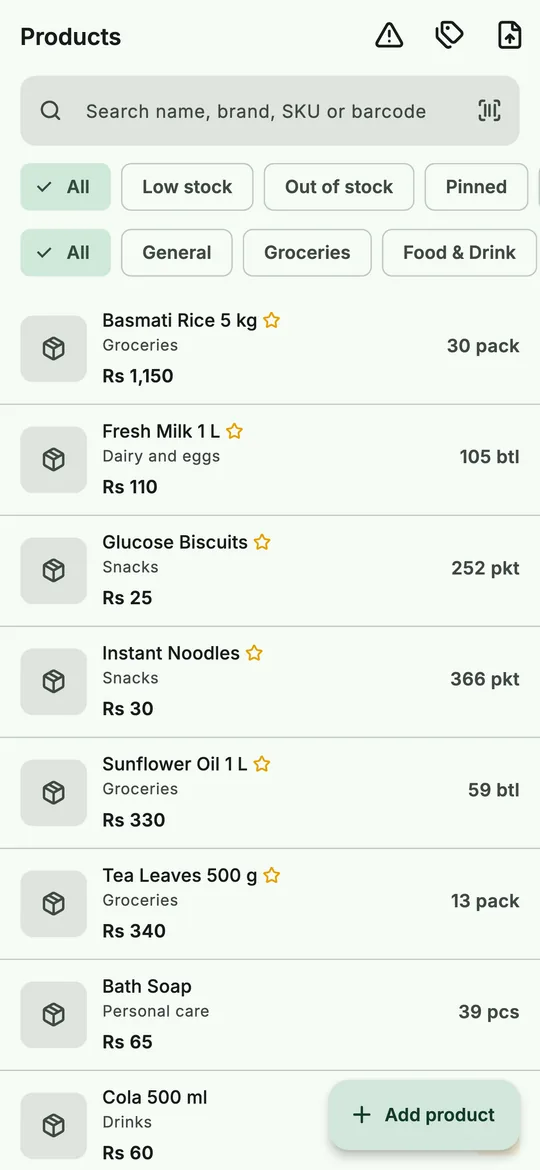 Every product's price and stock, with its cost and margin a tap away.
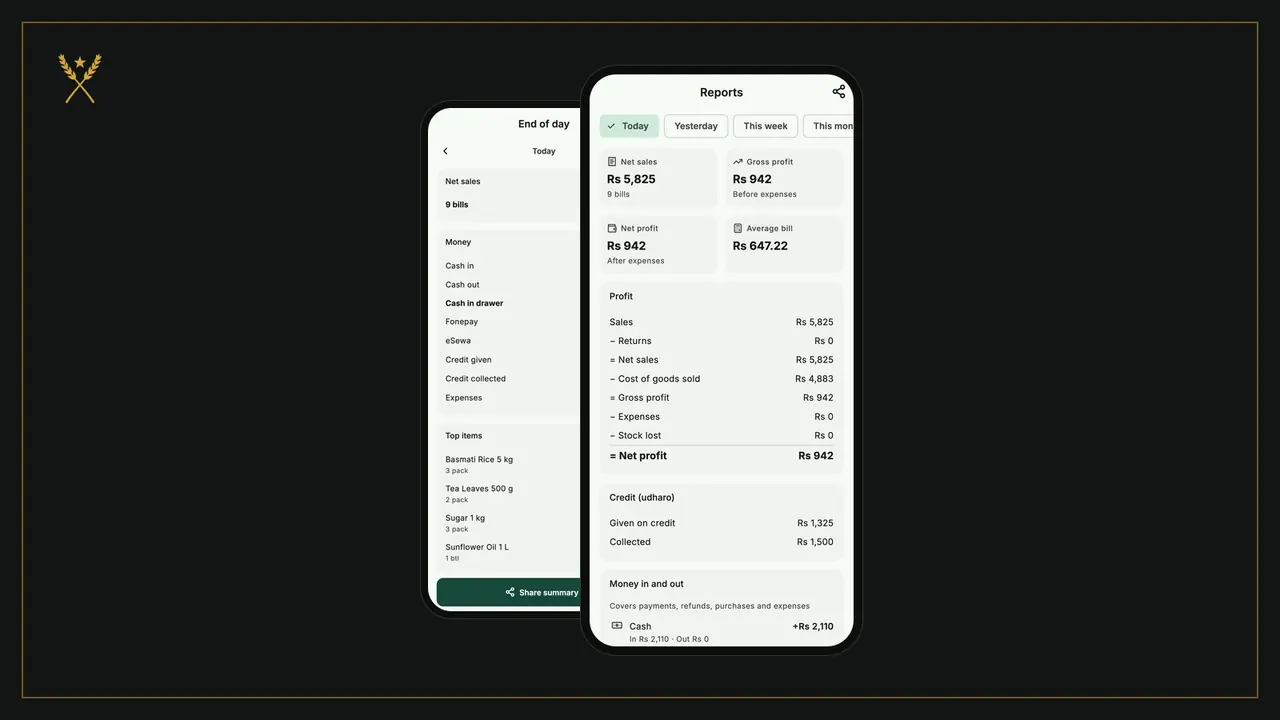
In BSMM, the free billing and stock app, every product shows its average cost and margin, and you can charge a different price or discount a line or a whole bill at the counter. The reports show profit and your best sellers for any period, so you know which prices matter most.
Questions shopkeepers ask
What is a good markup for a grocery store? It varies by item: staples often carry thin margins, while snacks and household goods carry more. Set yours from your real costs and check your monthly margin by item.
Is charm pricing (Rs 99) effective? It often is for items you price yourself, but it can cause change problems on small amounts. Test it on a few items and compare sales.
Can I sell above the printed MRP? No. In India and Nepal, selling above the printed maximum retail price is against the law. Check the current rules locally.
Related: how to increase profit in a small shop.